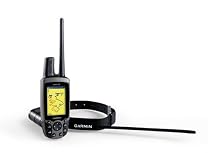
An Upgrade from their earlier astro (orange box style)

This astro should be pointed out that its fixed many of the bugs those of us early adopters encountered (like using velcro to attach anything to a dog was mistake 1).
The early versions featured an orange "box" with a non-amplified antenna built into the top of it plus a li-ion battery. You got a velcro harness to hold it on the dog and keep it pointing skyward. After 2-3 trips the velcro was full of hair and the antennas were being broken by anxious dogs racing through brush.
Garmin re-designed the astro and fortunately for us all we had to do was buy the upgraded collar design. The (now black) collar works the same but features an amplified antenna on top the electronics box down below where it naturally hangs and an improved longer antenna with better range (about 25% better in my testing)
From the top of one mountain I can now find my dog 7.48 miles away with almost full signal strength so this really works. Getting to the dog is another matter.
The collar transmits either every 5 10 or 30 seconds. 10 is a good value as you get about 2 days of use from the transmitter before the battery dies. 5 seconds will die in under a day (about 18 hours). These settings are made by placing the collar in close proximity to the handheld tracker and uploading them.
Finally for the radio folk the collar transmits on the MURS VHF frequencies at 2 watts digital. The frequencies are 151.82 151.88 151.94 154.57 (old analog radio channel - not a good choice) and 154.6 (same as 154.57) [all in MHZ]
The 151 frequencies provide the best range near towns becuase every fast food drive through uses the 154 frequencies to talk around. These correspond to the last 2 sets of 10 channels in the Astro.
If you are wondering how they get 10 channels on one frequency its simple - both the receiver and transmitter have GPS inside so they know EXACTLY when a second clicks by to a great precision. They then divide a time period (1 second) into 10 parts each 1/10 of a second long. Channel 23 for example specifies frequency 2 (151.94) and timeslot 3 - the 3rd 1/10 of a second after 0.00 seconds. Since the radio and the transmitter both know when the transmission will happen the radio tunes frequency 2 at 0.3 seconds after a second "ticks" to listen for the 1/10 second transmission from the collar.
The only problem with this is you can not put multiple collars next to each other as the receiver needs time to process the data it receives (about another 1/10 second) so if 151.94 is a good channel for you pick dog numbers of 21 23 25 27 and 29 if you have multiple dogs on one system or are hunting with another astro user. Also you can't have the radio tune different channels at the same time so don't pick dog A on channel 14 and dog B on channel 24 because their transmissions will be at the same time on 2 different freqencies.
Keeping those simple rules of separation in mind you can track alot of dogs a long ways with Astro.More detail ...


0 comments:
Post a Comment